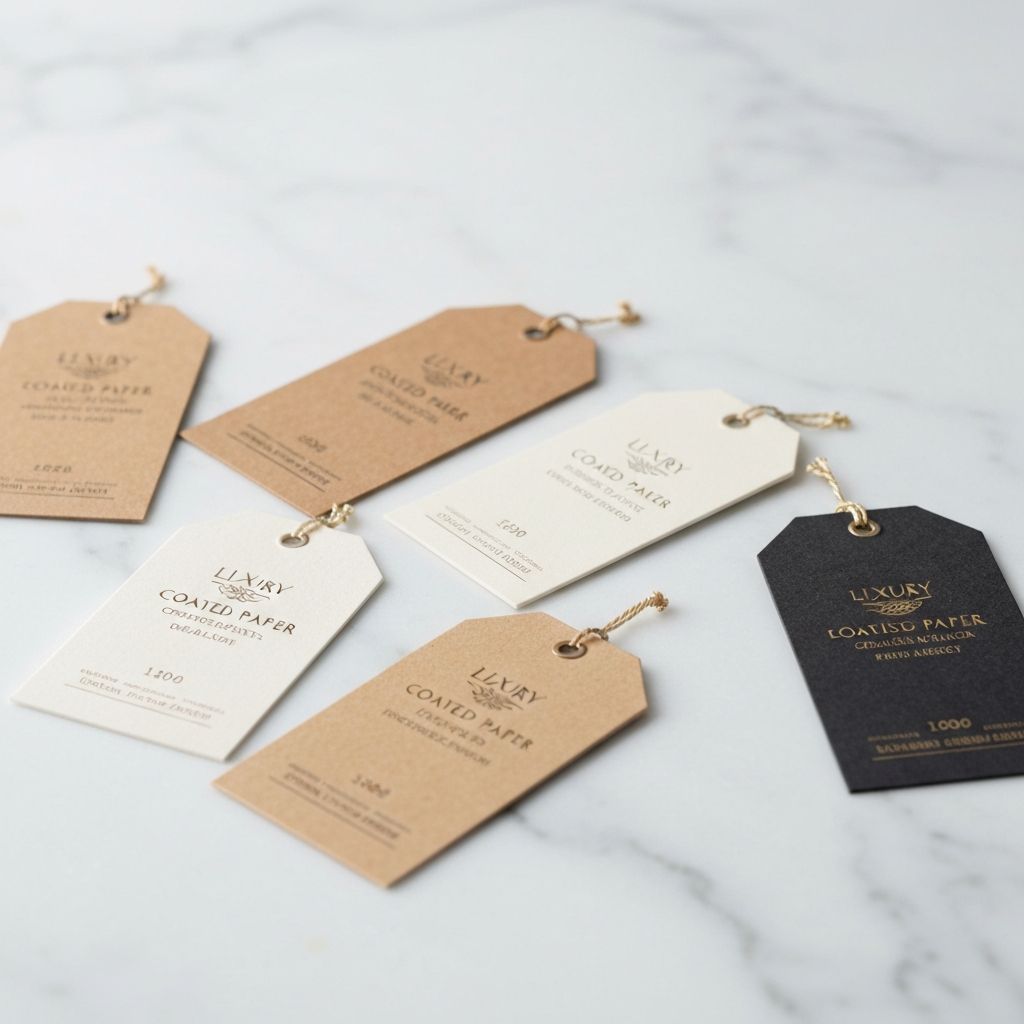
What Your Hang Tag Material Says Before Anyone Reads a Word
A Practical Guide to Substrate, Finish, and Brand Perception
The First 0.5 Seconds: How Hang Tag Substrate Shapes Brand Perception
Before a customer reads the price or scans the barcode, their fingers have already made a judgment. Touch a flimsy 250gsm uncoated tag versus a thick 600gsm cotton-board tag with a soft-touch laminate, and the brain registers the difference in under half a second. That split-second perception cascades into assumptions about garment quality, durability, and whether the brand respects its own product.
Retail psychology research consistently shows that tactile cues exert a measurable influence on purchase intent for clothing categories—and the hang tag is often the very first physical contact point between shopper and brand.
Breaking Down the Material Spectrum—From Paper to Polymer to Leather
The material landscape for garment hang tags can be organized into four broad families:
- Paper-based boards—the workhorse category, covering uncoated art card, coated art card, kraft board, cotton/seeded board, and recycled board. Together they account for roughly 65–70% of all garment hang tag volume globally.
- Plastic/polymer sheets—PVC and PP dominate here, with growing interest in PET. These represent about 15–20% of the market by volume but command a higher per-unit price.
- Leather and faux leather—genuine leather, PU-based vegan leather, and paper-based Jacron. This family accounts for less than 5% of total units but punches far above its weight in brand perception.
- Fabric, wood, and metal—woven cotton/nylon tags, laser-etched wood, and stainless steel plates. These are specialty items ordered in small MoQs for limited drops and heritage branding.
Paper Hang Tags Are Not All the Same—GSM, Coating, and Print Behavior
Lumping all paper hang tags into one bucket is the single biggest error non-specialists make. Paper is a category, not a spec.
Uncoated Art Card (350–500 gsm)
The default for mid-tier fashion and contemporary labels. It takes CMYK printing well, accepts matte or soft-touch lamination, and handles foil stamping and debossing with good results. Its tactile advantage is writability and a "natural" hand feel that aligns with minimalist branding aesthetics.
Coated Art Card (350–450 gsm)
Better ink holdout, more saturated color reproduction, and compatibility with spot UV and high-gloss lamination. This is the go-to for gift sets, cosmetics-adjacent brands, and any application where visual punch matters more than tactile warmth.
Kraft Board (300–450 gsm)
Brown kraft has exploded in popularity as the material shorthand for "natural" and "eco-conscious." Colors print more muted on kraft, so contrast management becomes critical. White ink or foils create the strongest visual impact on this substrate.
Cotton and Seeded Board (450–600 gsm)
The board itself contains visible cotton fibers or seed flecks, creating a textured, artisan feel that no printing process can replicate on smooth stock. Foil stamping and letterpress work brilliantly. Cost is 30–60% higher than standard art card.
| Paper Type | Typical GSM Range | Best Finishing Process | Cost Index | Best For |
|---|---|---|---|---|
| Uncoated art card | 350–500 | Foil, deboss, soft-touch lam | 1.0× (baseline) | Contemporary/minimalist brands |
| Coated art card | 350–450 | Spot UV, high-gloss lam | 1.1–1.2× | Gift sets, bold-color branding |
| Kraft board | 300–450 | White ink, foil stamp | 0.9–1.1× | Eco-positioned natural brands |
| Cotton/seeded | 450–600 | Letterpress, foil, deboss | 1.3–1.6× | Premium artisan heritage labels |
PVC Hang Tags: When Durability and Gloss Earn Their Keep
The phrase "PVC hang tag" triggers a split reaction in many buying offices. Durability teams love it. Brand sustainability officers eye it with suspicion. Both have valid points—and the decision usually comes down to whether the garment's use case demands what PVC delivers.
Rigid PVC at 0.5–0.8mm thickness brings properties paper simply cannot match: it is effectively waterproof, it resists tearing even with a harsh pull, and it won't soften or degrade on a rack near the fitting-room steamer.
| Property | Paper Tag (350gsm uncoated) | PVC Tag (0.5–0.8 mm) |
|---|---|---|
| Water resistance | Poor (absorbs, warps) | Excellent (impervious) |
| Tear resistance | Low | High |
| Edge curl after humidity | Noticeable | Minimal to none |
| Print resolution (CMYK) | Very good | Excellent (with UV print) |
| Tactile warmth | Warm, natural | Cool, synthetic |
| Unit cost (per 10K qty) | $0.04–$0.10 | $0.08–$0.18 |
| Consumer eco-perception | Generally favorable | Frequently negative |
Leather and Specialty Materials—The Costly Signal That Pays Back
Leather hang tags occupy a unique space in garment trim. At 1.0–2.0mm thickness, genuine leather carries physical weight that communicates permanence. Deboss a logo into vegetable-tanned leather, and the impression holds for the life of the garment—no print to scratch off, no edge to delaminate.
The category splits roughly into three tiers:
- Genuine leather (full-grain, vegetable-tanned): Highest cost, longest lead time, strongest heritage signal. Used by denim brands, luxury outerwear, and accessories labels.
- PU-based vegan leather: A polyester-backed polyurethane sheet that mimics leather texture at 30–50% of the cost of genuine.
- Jacron (paper-based leather alternative): A dense cellulose fiber sheet that looks and feels close to leather when embossed, but is fully biodegradable and vegan by default.
Finishing Processes: The Real Cost of Foil, Emboss, and Texture
Material sets the floor. Finishing sets the ceiling. But finishing also consumes the bulk of the production budget.
Foil Stamping
Metallic or pigmented foil bonded to the substrate via heated die under pressure. Gold and silver are classic; holographic and matte-color foils are expanding rapidly in streetwear. Cost adder per tag: roughly 20–40% over base print cost.
Embossing and Debossing
Raised (emboss) or recessed (deboss) relief created by pressing the substrate between male/female dies. Deboss on thick uncoated board creates the "quiet luxury" look that minimalism-driven brands favor. This adds roughly 25–35% to base cost.
Spot UV and Soft-Touch Lamination
Spot UV applies a high-gloss clear coat to selected areas, creating gloss-matte contrast on the same tag. Soft-touch (matte velvet) lamination coats the entire surface with a polymer film that feels like suede. Soft-touch has become nearly standard for mid-to-premium apparel because the tactile payoff is so high relative to the cost (10–15% adder).
Sustainability Pressures Reshaping Material Choices in 2025–2026
McKinsey's 2025 consumer packaging survey across 11 countries and 11,000+ respondents found that 66% of US and European consumers now consider sustainability a key factor in purchasing decisions. Other research puts the number even higher: 80% of consumers express a preference for eco-friendly packaging.
The practical implications for tag buyers:
- FSC-certified and recycled-content paper stocks are no longer premium upsells—they are becoming baseline expectations.
- Kraft board made from post-consumer recycled fiber carries a sustainability story that aligns naturally with organic-cotton brands.
- PVC tags face headwinds in markets with extended producer responsibility (EPR) regulations.
- Jacron and other paper-based leather alternatives are gaining interest because they offer the tactile premium of leather without the environmental concerns.
Material Selection by Brand Positioning
| Brand Tier | Recommended Material | GSM/Thickness | Key Finishing | Avoid |
|---|---|---|---|---|
| Fast fashion / value | Uncoated art card or recycled board | 300–400 gsm | Digital CMYK, matt lam | Over-finishing (destroys margin) |
| Contemporary / mid-market | Uncoated or coated art card, kraft | 400–500 gsm | Soft-touch lam, foil accents, deboss | PVC (low tier-perception risk) |
| Premium / bridge | Cotton board, seeded, thick kraft | 500–600 gsm | Letterpress, heavy foil, emboss | Thin stock below 400gsm |
| Luxury / heritage | Leather, Jacron, ultra-thick cotton | 1.0–2.0 mm (leather) | Deep deboss, gold foil, edge burnish | PVC, any plastic-feel substrate |
| Active / outdoor / swim | PVC or PP | 0.5–0.8 mm | UV print, matt lam | Paper (moisture failures) |
| Eco-positioned brand | FSC kraft, recycled board, Jacron | 300–500 gsm | Blind deboss, white ink, minimal foil | PVC, lamination-heavy designs |
What the Market Data Tells Procurement Teams Right Now
The global garment hang tag market was estimated at approximately USD 2.5 billion in 2025, with a projected growth to roughly USD 3.4 billion by 2031. The wider fashion and apparel print labels market was sized at approximately USD 3.28 billion in 2025 and is projected to reach USD 6.64 billion by 2035, growing at a 7.3% CAGR.
Technology forcing function:The RFID integration trend is reshaping hang tag material decisions. Walmart's RFID mandate, expanded in 2024 and further tightened in 2025, requires item-level tagging across apparel. When an RFID inlay must be embedded inside a hang tag, the substrate choice affects antenna performance and read range.
Final Thoughts
Hang tag substrate selection follows a logic that is straightforward but often ignored under deadline pressure: match the material to the garment's actual use environment and the brand's actual positioning, not to an aspirational image disconnected from what the tag will physically endure.
The most underrated skill in tag procurement is knowing when to stop upgrading. Every additional gram of board weight, every extra finishing pass adds cost—but beyond a certain threshold, the customer doesn't notice, and the margin bleeds for no perceptual return.
Need Custom Garment Accessories?
From hang tags to woven labels, we manufacture premium garment accessories tailored to your brand's needs.
Get a Free Quote